While I generally find a lot of online political discourse pitifully by-numbers and prone to simplistic, "so, what's in the papers" nodding-dog-ism you occasionally stumble across a screed of online opinion that makes the hairs on the back of your neck stand up.
Below is possibly the most inspiring thing I have read this week.
Some small edits from the posted article and addition of my own emphasis.
" My experience of union meetings though is that there is a vast reservoir of libido waiting to be tapped; at meetings, there was an animated disaffection with auditing and new bureaucracy which immediately dissipated when the 'official' agenda - pay and strikes - was dutifully returned to.
New forms of industrial action need to be instituted against managerialism.
For instance, in the case of teachers and lecturers, the tactic of strikes (or even of marking bans) should be abandoned, because they only hurt students and members...
What is needed is the strategic withdrawal of forms of labour which will only be noticed by management: all of the machineries of self-surveillance that have no effect whatsoever on the delivery of education, but which managerialism could not exist without.
Instead of the gestural, spectacular politics around (noble) causes like Palestine, it's time that teaching unions got far more immanent, and take the opportunity opened up the crisis - their crisis, our opportunity... - to begin to rid public services of business ontology. (When even businesses can't be run as businesses, why should public services?)"
The increasing managerialisation extends beyond education into every sphere of social engagement, the necessity that outcomes of unstarted programmes be drafted and agreed on before anyone's got in a room to discuss the practical work of funded projects, pervades most forms of cultural engagement (in the broadest sense, including the arts, sports and any form of work with young people). The priority to legitimise all money spent rather than the boring, invisible, yet substantive and crucial element to any form of engagement, namely the development of human relationships and the time and effort required for these to bear fruit.
This managerialisation prioritises an immediate, ephemeral, illusory impression of work ahead of the sloppy, unreliable, frequently tardy yet real and lasting reality of any form of constructive and deeply engaged practice. With the papers full of spending squeezes and efficiency savings the overriding impression is that more time will be spent accounting for money spent and less time spent engaged in actual activity.
In times when there's less money around surely the one resource we should be afforded more of is time?
Thursday, 23 April 2009

Wednesday, 1 April 2009
Upside to Downturn with Downsize Reprise
Belated bleating return to the lately neglected posting.
 Last Friday saw the long awaited return of Downsizesound, a sort of preparatory post-apocalyptic hoe-down.
Volk-mensch Drew Wright aka Wounded Knee ("A man hard at play"- Plan B, "a collaboration between Scatman John, Steve Reich and Alasdair Roberts"- Alternative Ulster, "Tuvan-Paul Robeson throat singing"- Buzz, "We won’t be needlessly cruel, but avant-garde is still French for bullshit"- NME) was joined by Alisdair Roberts, Issho Taiko Drummers and One Ensemble's Peter Nicholson for an evening of strange, ageless chicanery, electricity free.
Wright's opening gong assisted incantation welcomed us in a cheery, well considered hymn before getting down to his purple scanties, jaunty socks and snug fitting vest in a shameless piece of exhibitionism designed to get a large turnout on side. Mission accomplished and away we went. Plugged in the Knee ranges over a lot of territory, incorporating ideas from super traditional Scottish folk to noise, to Sun Ravian freeness, to house music and out to a ever sprawling transit through world musics. In downsizing he still managed to fit a lot in, an audience-assisted noise piece dedicated to ill friend, collaborator and drone prince Fordell Research Unit, some old favourites (21st century worksong "Lanyard", the hummable, plaintive ecological call of "Canary"), devastating, age-old folk songs like "Glenlogie" and "The Dowie Dens of Yarrow" were interspersed with illuminating and engaging introductions to the songs and great singers and recordings of them. He finished positing the interesting and convincing theory that come a world where our worst predictions are realised that the humble cassette tape will be our only remaining available connection with recorded history before wondering whether his final tape would be the ones we treasure more. He pressed play on a battery operated tape machine and a tape of birdcall, complete with RP-inflected commentary. A magical and evocative beginning from someone who is clearly comfortable in their skin, practice and possessed of a burgeoning creative energy. Well done fella!
A quick pee and beer break later and One Ensemble's Peter Nicolson launched into a stirring set with a (open to correction) Central European folk song that suits his soaring voice and cello to a t. He played a longer free piece that was riveting, as he careened up to the bridge, playing high, jarring staccato, jagged wrong notes and leaping around matching his voice to each and every note. I don't know enough about Nicolson's work to speculate but he's a virtuosic player without ever shutting an audience out, although some people I spoke to found it really intense, coiled and nervy and dark. Not necessarily a bad thing.
I was a bit overawed by the Alasdair Roberts performance, had heard a couple of his albums but never really returned to them, this was the first time I was able to see him live after repeatedly been too lazy to go and see him. It's difficult to describe the music he makes, you could call it folk or traditional or even stick him alongside the likes of Smog or Will Oldham or Joanna Newsom but I don't think it really does him justice. Some of the new songs from his new album "Spoils" are absolutely fantastic, especially "Eternal Return" and a hilarious and cynical about the three aspects of Man that inspire us all to be "complete bastards". His lyrics are complex and on the surface can seem a bit hokey, there's much talk of types of trees and birds and esoteric heraldry but have a pleasantly baffling contemporary resonance. He's a really inquiring, questing writer and his lyricism is occasionally flabbergasting. Sometimes when he delivers a line it's a bit like the sun coming out, it actually warms your face to hear it, the lines elemental inevitability is exhiliarating. Steady!
To finish the evening off we had the Ishoo Taiko Drummers. Four Taiko drums dominated the setup all evening and I alternated between excitement and apprehension, I've been to too many places where bombastic, directive massed drumming completely batters any sense of nuance out of a performance. Ishoo are a fundamentally "plugged" group, as a band member said early on the show required a significant rethink of how they'd perform. A beautiful introductory piece with restrained taiko tempos, acoustic guitars and flickering flute stops quickly dispelled any fear this was going to be a juddering, predictable drum circle. A later piece used four tuned acoustic guitars played with steel skewers, letting the reverberations echo through the space. A later piece saw two performers demonstrate the xylophone's hypnotic synthy possibilities in a piece that was strongly reminiscent to everything that's wonderful about Steve Reich, a sort of motorik, percussive Mogwai.
I ended up buying a CDR on the strength of the performance which was a great end to an interesting and varied evening. Well done and thanks to Drew to organising it.
Hopefully I'll get some pictures from the evening.
Everyone loves pictures of a man in purple pants.
Last Friday saw the long awaited return of Downsizesound, a sort of preparatory post-apocalyptic hoe-down. Volk-mensch Drew Wright aka Wounded Knee ("A man hard at play"- Plan B, "a collaboration between Scatman John, Steve Reich and Alasdair Roberts"- Alternative Ulster, "Tuvan-Paul Robeson throat singing"- Buzz, "We won’t be needlessly cruel, but avant-garde is still French for bullshit"- NME) was joined by Alisdair Roberts, Issho Taiko Drummers and One Ensemble's Peter Nicholson for an evening of strange, ageless chicanery, electricity free.
Wright's opening gong assisted incantation welcomed us in a cheery, well considered hymn before getting down to his purple scanties, jaunty socks and snug fitting vest in a shameless piece of exhibitionism designed to get a large turnout on side. Mission accomplished and away we went. Plugged in the Knee ranges over a lot of territory, incorporating ideas from super traditional Scottish folk to noise, to Sun Ravian freeness, to house music and out to a ever sprawling transit through world musics. In downsizing he still managed to fit a lot in, an audience-assisted noise piece dedicated to ill friend, collaborator and drone prince Fordell Research Unit, some old favourites (21st century worksong "Lanyard", the hummable, plaintive ecological call of "Canary"), devastating, age-old folk songs like "Glenlogie" and "The Dowie Dens of Yarrow" were interspersed with illuminating and engaging introductions to the songs and great singers and recordings of them. He finished positing the interesting and convincing theory that come a world where our worst predictions are realised that the humble cassette tape will be our only remaining available connection with recorded history before wondering whether his final tape would be the ones we treasure more. He pressed play on a battery operated tape machine and a tape of birdcall, complete with RP-inflected commentary. A magical and evocative beginning from someone who is clearly comfortable in their skin, practice and possessed of a burgeoning creative energy. Well done fella!
A quick pee and beer break later and One Ensemble's Peter Nicolson launched into a stirring set with a (open to correction) Central European folk song that suits his soaring voice and cello to a t. He played a longer free piece that was riveting, as he careened up to the bridge, playing high, jarring staccato, jagged wrong notes and leaping around matching his voice to each and every note. I don't know enough about Nicolson's work to speculate but he's a virtuosic player without ever shutting an audience out, although some people I spoke to found it really intense, coiled and nervy and dark. Not necessarily a bad thing.
I was a bit overawed by the Alasdair Roberts performance, had heard a couple of his albums but never really returned to them, this was the first time I was able to see him live after repeatedly been too lazy to go and see him. It's difficult to describe the music he makes, you could call it folk or traditional or even stick him alongside the likes of Smog or Will Oldham or Joanna Newsom but I don't think it really does him justice. Some of the new songs from his new album "Spoils" are absolutely fantastic, especially "Eternal Return" and a hilarious and cynical about the three aspects of Man that inspire us all to be "complete bastards". His lyrics are complex and on the surface can seem a bit hokey, there's much talk of types of trees and birds and esoteric heraldry but have a pleasantly baffling contemporary resonance. He's a really inquiring, questing writer and his lyricism is occasionally flabbergasting. Sometimes when he delivers a line it's a bit like the sun coming out, it actually warms your face to hear it, the lines elemental inevitability is exhiliarating. Steady!
To finish the evening off we had the Ishoo Taiko Drummers. Four Taiko drums dominated the setup all evening and I alternated between excitement and apprehension, I've been to too many places where bombastic, directive massed drumming completely batters any sense of nuance out of a performance. Ishoo are a fundamentally "plugged" group, as a band member said early on the show required a significant rethink of how they'd perform. A beautiful introductory piece with restrained taiko tempos, acoustic guitars and flickering flute stops quickly dispelled any fear this was going to be a juddering, predictable drum circle. A later piece used four tuned acoustic guitars played with steel skewers, letting the reverberations echo through the space. A later piece saw two performers demonstrate the xylophone's hypnotic synthy possibilities in a piece that was strongly reminiscent to everything that's wonderful about Steve Reich, a sort of motorik, percussive Mogwai.
I ended up buying a CDR on the strength of the performance which was a great end to an interesting and varied evening. Well done and thanks to Drew to organising it.
Hopefully I'll get some pictures from the evening.
Everyone loves pictures of a man in purple pants.
Wednesday, 18 March 2009
Credit to the Nation.
Thanks to all the fine Irish patriots who last night contributed to the stinking lake of boozy urine all along the Cowgate.
There's nothing that makes an Irishman prouder than the rancid pissreek of his compatriots.
Hail. Glorious. Etc.
There's nothing that makes an Irishman prouder than the rancid pissreek of his compatriots.
Hail. Glorious. Etc.
Tuesday, 17 March 2009
Adjective invective

Jonathan Meades, broadcaster, writer and most wonderful man on the planet sticks his exquisitely polished loafers into "iconic" and its lazy, arbitrary usage in a profession that is evidently aware, but way past caring it's on its deathbed.
"Here are some nouns and compound nouns that have been prefixed by this most dismal of vogue words. These are all found constructions of recent provenance: none is my invention.
...
iconic injury-time winner, iconic itinerary, iconic jihad target, iconic jigsaw, iconic jingle, iconic jockey, iconic joke, iconic kitchen utensil, iconic knife, iconic knowledge, iconic lawnmower, iconic leprechaun, iconic light fitting, iconic lion, iconic lip balm, iconic mascara, iconic milkshake, iconic mittens...iconic radiator, iconic relationship, iconic restaurant, iconic retail mall, iconic robot, iconic rodent, iconic saddle, iconic sandwich, iconic sausage, iconic shampoo, iconic shoe, iconic shoehorn, iconic shop, iconic silhouette, iconic snack food..."
Impassioned, erudite, thought provoking and delivered with characteristic rhetorical élan, I could read his prose all day and night.
For those who haven't entered the invigorating, sardonic cult of Meadues you could do worse than to dig up the BBC DVD of Jonathan Meades Collection which is a compilation of some of his unique TV programmes from 1990-2007.
Try to ignore the fact that the dullards at 2entertain didn't bother their lazy arses licensing the original music and you're left with dreary MIDI tracks where a brilliant soundtrack enhanced Meades' high-falutin' grand guignol on topics as diverse as 1960's church design, uterine yearning in Finnish modernism and East Anglia as a marooned extension of Holland.
There are also links to a number of articles on Clive James page who describes him as "an educated upstart who not only doesn’t know his place, but knows far more than his allotted share about all the other places."
More Meades related wonderfulness in the New Statesman in which he digs up Kenneth Clark and defiles the memory of the respected"Civilisation" series saying "If the Edwardians had had telly, this is what they would have put on it: it was stately, formal and ponderous."
Oh sweet suffering...
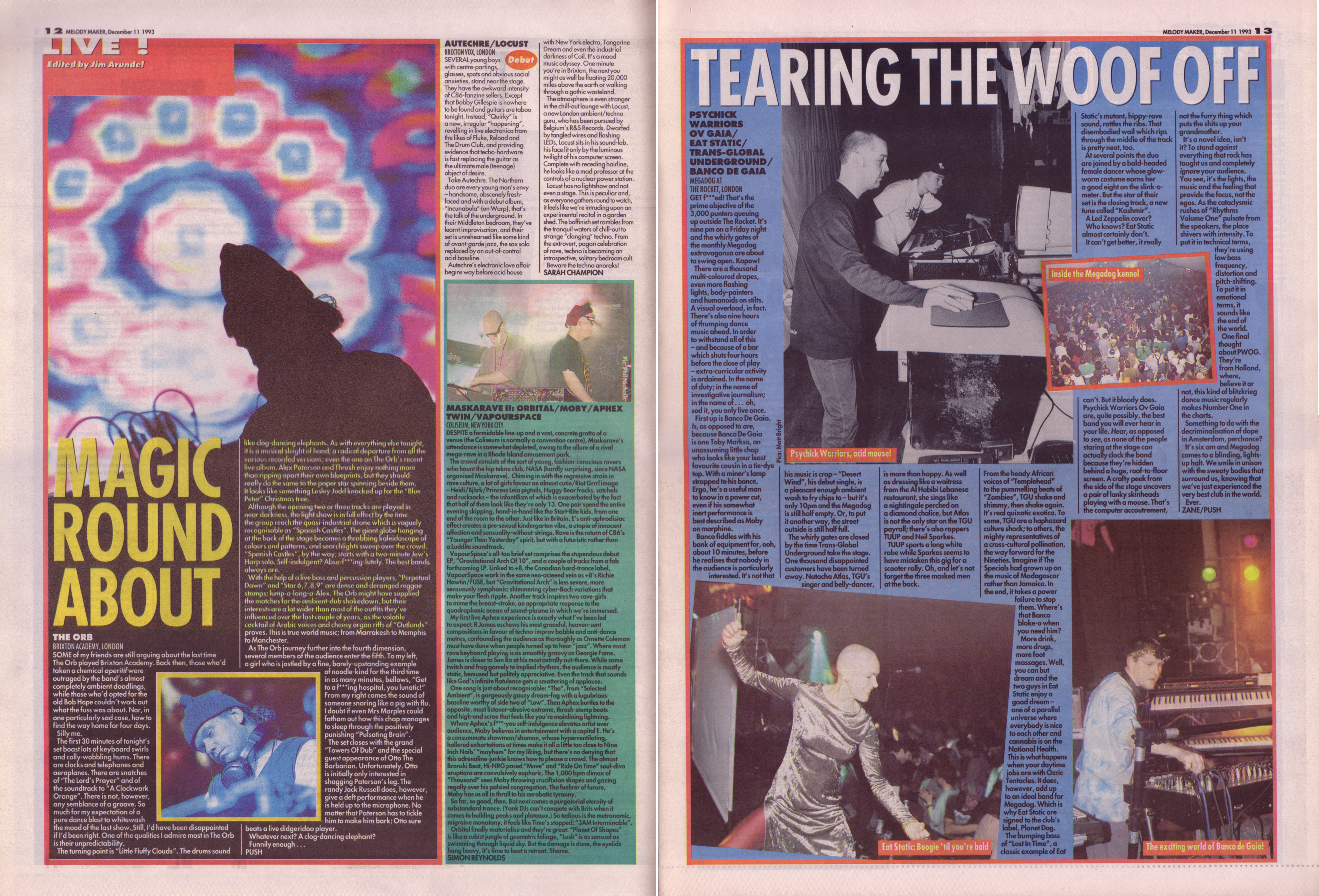
Archived music press' feature on early live UK techno.
My particular fave is Reynolds' contention that "Yank Dj's can't compete with Brits when it comes to building peaks and plateaux".
Peerless and utterly groundless snarking from the 'nuumfinder general, along with some supreme prime high-hattery about "regressive strain in rave culture...exacerbated by the fact that half of them look like they're only 13".
My particular fave is Reynolds' contention that "Yank Dj's can't compete with Brits when it comes to building peaks and plateaux".
Peerless and utterly groundless snarking from the 'nuumfinder general, along with some supreme prime high-hattery about "regressive strain in rave culture...exacerbated by the fact that half of them look like they're only 13".
Tuesday, 10 March 2009
Dirty Deeds Done Dead Cheap

Amazing stuff here with an inventor/creator/mad genius making an instrument a day for a month. There are so many great ideas here, the best/most useful design is probably the mobius strip but i think the garden turntable (pictured) is the barkingest, most wonderful thing I've seen this year! Photos, videos, sound samples; follow the link.

This was a part of a wider "Thing-a-day" project where people made one item per day for the entire month of February, the kind of thing that makes me feel phenomenally lazy.
Seen on and stolen from AudioLemon.
Friday, 6 March 2009
A square peg in a round (k) hole

The seemingly endless theoretical wrangling over the existence and extent of the fabled "Hardcore Continuum" reaches something approaching a tabloid bunfight today as noted theory gonk, Simon Reynolds (someone for whom the existence of the HC represents a something of a meal ticket) kicked wonky to the HC curb for ideological heresy.
The crime? Not fitting neatly with Reynolds' thesis and key producers rejecting Reynolds' analysis (and possibly implying that he's, like totally old). What emerges from this little narrative can be summarised thus:
The crime? Not fitting neatly with Reynolds' thesis and key producers rejecting Reynolds' analysis (and possibly implying that he's, like totally old). What emerges from this little narrative can be summarised thus:
Reynolds
Heaven forfend! The struggle for the discursive high-ground regarding wonky fails to see the energy, invention and excitement in that "scene" at the moment.It seems Reynolds would prefer if the major players conformed more to geographical or ideological boundaries, he seeks to
I like Reynolds' writing, he's written some superb analyses of significant recent music history. But there are limitations to how far you can apply theory to reality. Throughout the history of dance musics there has been a "folk" element to certain scenes, locality and the sense of community that's formed through friendships and going to the same parties, listening to the same records, hanging out in the same pubs all contribute to productions.
Disco in 1970's New York was a diverse genre with certain clubs forging a distinct musical identity. From this chaos history is made, certain records were deemed "Garage" records, certain ones "Loft", certain ones "Studio". The Glaswegian Numbers crew are clearly influenced by Dopplereffekt and other US musics, undoubtedly through the Club 69/Rub a Dub crew. This is its own continuum, one that doesn't begin and end at the Watford Gap.
The Scottish Hardcore continuum (if such a thing even exists) is a significantly different beast (and has a different legacy) to that of, say Ireland. Through donning the straitjacket of Reynolds' theory we only see part of the picture, and one that is possibly seen through the rosy tinted specs of hindsight.
In a recent post, ISM's Pipecock really articulates the excitement of discovery, the simple joy of playing, listening to and losing your mind to records; looking to a musical continuum that isn't theoretical, one that's personal, that's formed through friends, great parties and just fucking doing it without fully understanding it.
One that "inspired damn near everyone I know to go buy record by cats like Drexciya and Basic Channel and start throwing them in the mix with any old funky electronic shit we could find."
Amen to that.
Subscribe to:
Posts (Atom)